How robotics is helping — not replacing — the people behind our food.
The fruit in your fridge, the ready meal in your bag and the tomatoes in your lunch all passed through a packing line. For decades, people have handled much of that work by hand, often repeating the same demanding movement thousands of times in a shift.
Today, labour shortages are making those teams harder to build and retain. For food producers, including smaller and family-run businesses, robotics is increasingly stepping into roles that cannot reliably be filled. This is not automation for its own sake. It is a practical way to keep food moving, shelves stocked and existing teams supported.
The pressure on packing teams
Packing lines are fast, repetitive and physically demanding. They require stamina, focus and consistency, while even a small staffing gap can affect output, fulfilment and retailer relationships. Retirements, changing career expectations, post-Brexit labour availability, rising living costs and the lasting effects of the pandemic have all made recruitment more difficult.
The challenge is especially acute in rural and semi-rural locations, where many food production sites operate. A UK Parliamentary Committee has described the food and farming sector's labour shortage as a permanent shortfall requiring long-term solutions.
What a pick and place robot actually does
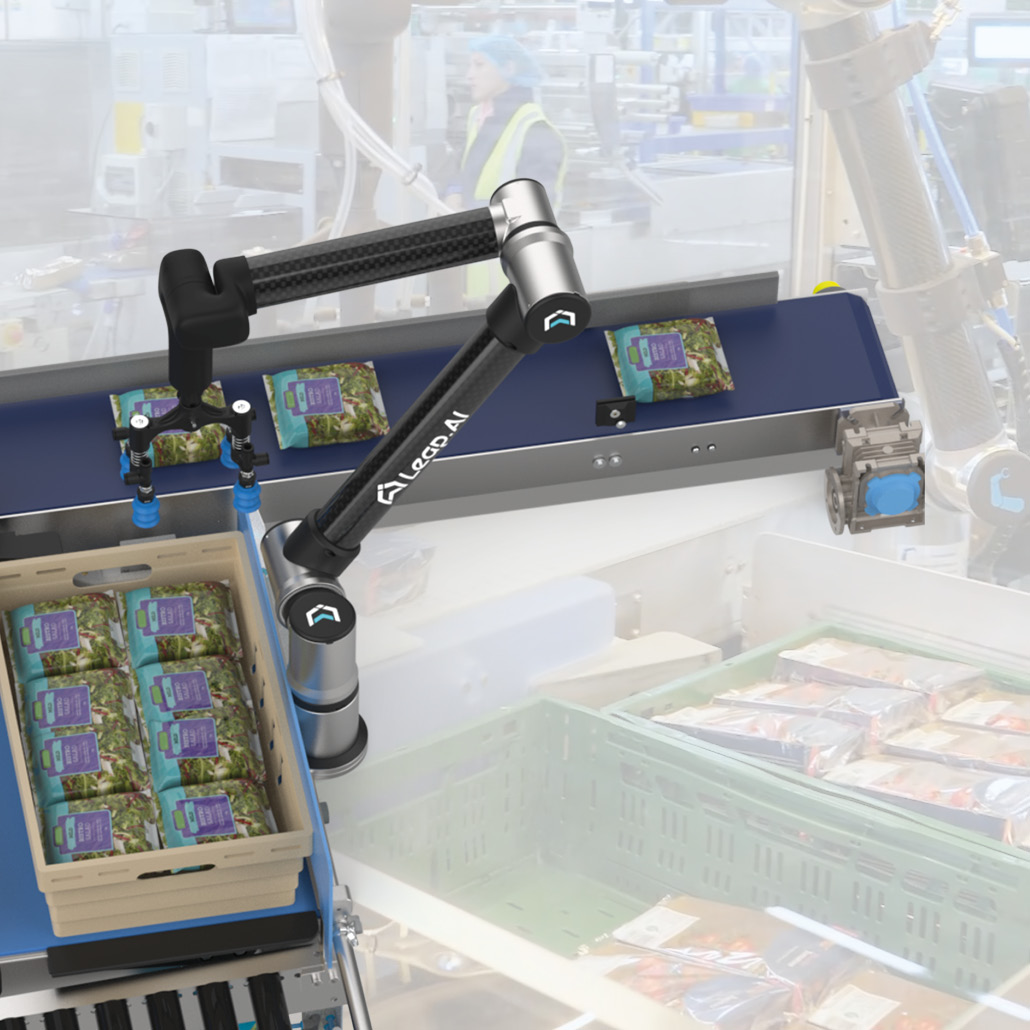
Factory robots are usually far removed from the humanoid machines of science fiction. A pick and place system typically combines an industrial robot, a purpose-designed gripper and vision technology. It identifies a product, assesses its position and orientation, then places it reliably into the correct tray, crate or case.
That makes robotics well suited to tasks that are repetitive, physically tiring and dependent on consistent cycle times. Modern vision-guided systems can also adapt to variation on the line, handle different products and formats, and integrate with existing production equipment.
The robot takes responsibility for one defined part of the process. People remain essential for oversight, quality, decision-making and the many adjustments that require human judgement. The result is collaboration: automation absorbs the repetition while the team focuses on higher-value work.
Why smaller producers are automating
Automation was once associated mainly with large manufacturers that had extensive engineering teams, floor space and capital. That is changing. Systems are becoming more compact, easier to deploy and flexible enough to fit existing lines. For small and mid-sized producers, automation can now be a realistic response to immediate operational pressure.
A reliable packing system helps stabilise output when staffing is unpredictable, reduces physical strain on the people who remain and gives managers greater confidence when planning production. In many cases, it protects the viability of the business and the jobs it already provides.
Florette: measurable impact in three days
Prepared-salad producer Florette needed greater consistency, speed and flexibility on a line handling delicate bags of salad. Leap AI installed PikPak™ in December 2022 and commissioned the system in three days. More than 25 members of staff were trained in two days, allowing the robot to begin working alongside the existing team quickly.
Packing speed increased by more than 25%, reliance on manual labour reduced and the team gained greater stability in a part of the process that had been under sustained pressure.
“The introduction of PikPak™ has brought immediate results to our business. The speed and accuracy of packing, combined with the ease of use and responsiveness of Leap AI's support, has made a real difference on the line.”
Automation changes work; it does not remove people
Concern about the effect of automation on jobs is understandable. Yet many food producers are not choosing between a person and a robot. They are choosing between filling a persistent labour gap with automation or allowing capacity, quality and service to suffer.
When a robot takes on repetitive packing, existing employees can move towards supervision, quality checks and other parts of production that depend on flexibility and judgement. The nature of the work changes, but people remain central to the operation.
A more resilient route from packhouse to shelf
Consumers rarely see the hundreds of actions behind a stocked shelf. When a packhouse cannot maintain pace, orders are delayed, mistakes increase and product quality can suffer. Pick and place robotics helps protect that everyday consistency, particularly for producers that do not have spare capacity to absorb disruption.
The right automation can also help businesses keep production local and operations sustainable. Robots are already packing tomatoes, handling salad bags and filling cases — not to take people out of food production, but to make demanding work more manageable, repeatable and reliable.
At Leap AI, we build vision-guided robotic systems for food producers and packhouses. Our aim is simple: help teams do more of what matters, with less strain and greater consistency.
Vivienne Hsu, CMO, Leap AI — media@helloleap.ai
Looking to improve your packing operation?
Find out what PikPak™ could do for your lines — we aim to respond within 24 hours.