Pick and place robots are coming… to pack your veggies
How robotics is helping – not replacing – the people behind our food
The fruit in your fridge. The ready meal in your bag. The tomatoes in your lunch. At some point, they all passed through a packing line – and someone had to put them there.
For a long time, that someone was a person. Often many people, working long shifts, repeating the same task thousands of times a day. But as labour shortages grow and demand holds steady, those people are getting harder to find. In more and more factories – some of them small, independent, or family-run – that job is now being done by a robot.
That might sound high-tech or impersonal. It isn’t. These aren’t robots replacing people. They’re stepping in where there simply aren’t enough people to do the work. Not to disrupt, but to support. Not to take over, but to keep things going.
While headlines warn of automation and AI threatening livelihoods, the reality is more grounded. In many places, pick and place robots are helping to keep food moving, shelves stocked, and small businesses afloat.
The reality of factory work
Packing lines are often the most physically demanding part of a production process. The pace is fast, the movements repetitive, and the margin for error small. It’s work that requires stamina, focus, and consistency – shift after shift. For a long time, teams of people made this possible. But increasingly, those teams are hard to find.
There’s no single reason for the shortage. It’s a combination of long-term and recent shifts:
Older workers are retiring, and younger generations are less likely to step into these roles. Post-Brexit, many factories have struggled to replace EU labour, especially in food production. Meanwhile, the cost of living has risen faster than wages in many manual jobs, making them less attractive. The work itself is tough, and burnout is common. Add to this the effects of the pandemic – many workers left the sector and haven’t returned – and recruitment becomes even more difficult.
In rural or semi-rural areas, where many of these factories are based, the challenge is even greater. It’s not just that people are turning the work down. In some places, there simply aren’t enough people available to do it.
These pressures aren’t unique to one business or region. They’re part of a broader pattern that’s been recognised at the national level. A UK Parliamentary Committee recently concluded that the food and farming industry is facing a “permanent shortfall” in available labour – a shortage that requires long-term solutions.
Source: Labour shortages in the food and farming sector – UK Parliament Committee
What factory robots actually do
When people hear the word “robot,” they often picture something humanoid – maybe a machine with arms and legs, blinking lights, and a voice that sounds faintly like a satnav. The reality is far simpler.
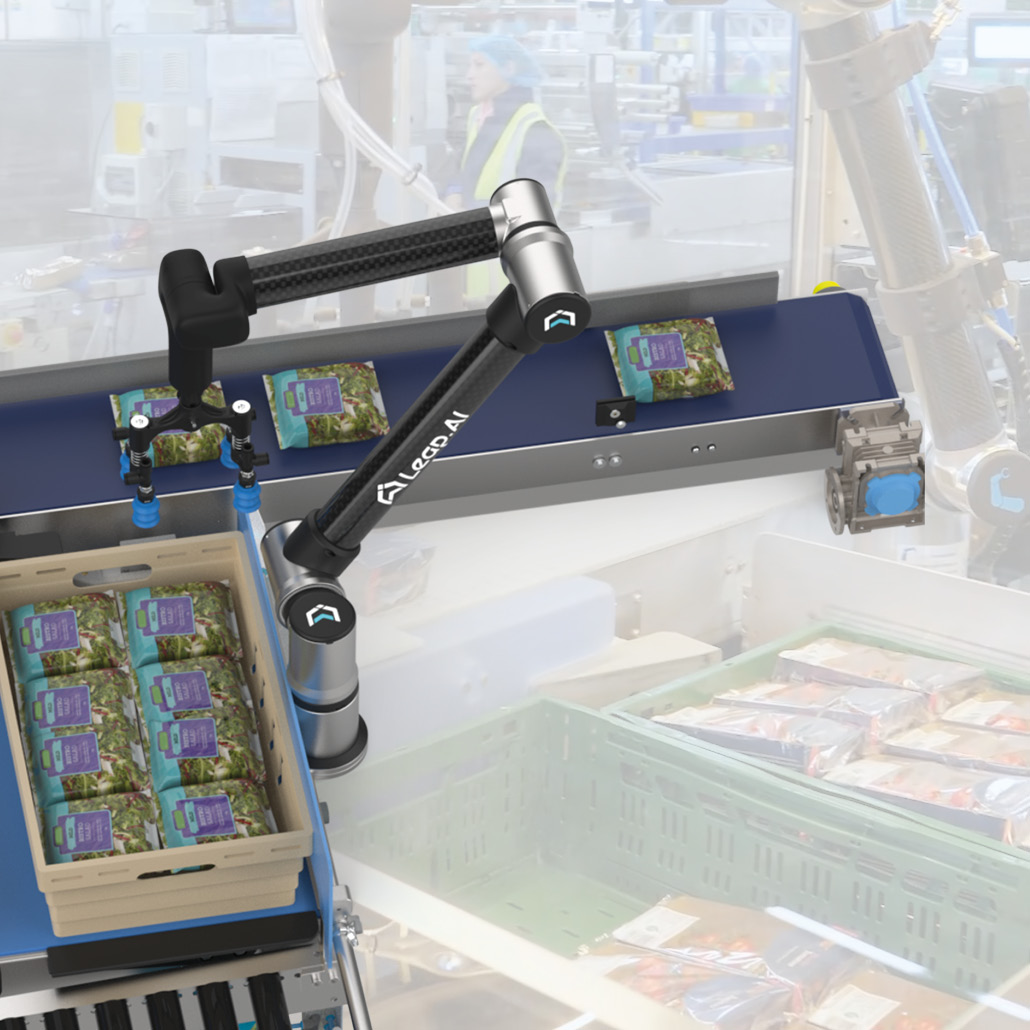
In most factories, a robot doesn’t look like anything from science fiction. It’s often a fixed or articulated arm, equipped with a suction cup or gripper, programmed to do one task very well. In food production, that task is usually picking up an item – like a packet of salad or a tray of ready meals – and placing it into a box, tray, or crate. Over and over again, with speed and consistency.
These are called pick and place robots. They don’t operate like people, and they don’t make decisions in the way a human would – but pick and place robots are highly capable at what they’re designed to do. With the right programming and sensing, pick and place robots can pick up a product, assess its position or orientation, and place it reliably where it needs to go. Pick and place robots are fast, consistent, and well-suited to tasks that are physically demanding or repetitive for human workers.
As technology continues to improve, these systems are becoming more intelligent – able to adapt in real time to changes on the line, handle a greater variety of products, and integrate with other parts of the production process. But at their core, pick and place robots remain tools: specialised machines built to support the people around them.
Modern systems often include vision technology, allowing them to recognise different product types or adjust for changes in placement or alignment. This kind of flexibility is especially valuable in smaller or mixed-product environments, where manual work can be slow and error-prone.
And crucially, pick and place robots aren’t replacing entire teams – they are joining them. They take on one part of the process, usually the part that wears people down the fastest. The rest – oversight, decisions, adjustments, and quality control – still depends on human judgement. That’s where the real collaboration happens.
Why small factories are turning to robots
Automation has often been associated with large-scale manufacturers – those with the budget, floor space, and dedicated engineering teams to make it work. But that’s changing. In recent years, more small and mid-sized factories have started introducing robots to their production lines. Not to compete with tech giants, but to stay afloat under mounting pressure.
For many of these businesses, the decision isn’t driven by ambition. It’s driven by necessity.
Labour shortages, unpredictable staffing, and growing demand all put pressure on the same part of the process: the packing line. When even a small delay or shortfall in staff can affect output, fulfilment, and relationships with retailers, automation becomes less of a future-facing investment and more of a short-term solution.
Pick and place robots are increasingly being used to stabilise these vulnerable points. They help maintain output when teams are stretched. They reduce the strain on staff who are still there. And they allow factory managers to plan with greater confidence, even when recruitment is uncertain.
Importantly, the technology has become more accessible. Modern systems are smaller, easier to install, and designed with flexibility in mind. They can be fitted into existing lines, adjusted for different product types, and used without needing a full in-house engineering team. For many small factories, that ease of integration is what makes the move to automation finally feel realistic.
This shift isn’t about replacing people. It’s about making sure the business – and the jobs it already provides – can continue. In many cases, the introduction of pick and place robots helps factories keep going when they otherwise might not.
A real example: helping a team under pressure
One example comes from Florette, a well-known producer of prepared salads. Like many in the food industry, they faced seasonal labour shortages and increasing pressure to meet demand. Their packing line – handling delicate bags of salad – needed more consistency, speed, and flexibility than manual labour alone could sustain.
After assessing several options, Florette chose Leap AI’s PikPak™ robotic system. The system was installed in December 2022 and commissioned in just three days. Over 25 staff members were trained in two days, and the pick and place robot has been operating alongside the team ever since.
The impact was immediate: packing speed increased by over 25%, reliance on manual labour decreased, and the team gained more stability in a part of the process that had been under constant strain.
“The introduction of PikPak™ has brought immediate results to our business. The speed and accuracy of packing, combined with the ease of use and responsiveness of Leap AI’s support, has made a real difference on the line.”
– Site Manager, Florette
It’s a clear example of what automation can look like when it’s done well – quick to implement, easy to adapt, and built to support the people already in place.
So… are jobs disappearing?
It’s the question that often comes up first: if pick and place robots can do the work, what happens to the people who used to do it?
It’s a fair concern – and one that deserves a straight answer. In some sectors, automation has led to job losses. In others, it has created entirely new roles. But in many small factories, the picture is less dramatic. Jobs aren’t being replaced – they’re becoming harder to fill in the first place.
Packing work is physically demanding, repetitive, and often low paid. Turnover is high, and recruiting reliable staff is increasingly difficult. The reality for many businesses is that they aren’t choosing between people and robots – they’re choosing between using automation or falling behind.
When a pick and place robot takes on a task like packing, it’s usually stepping into a gap, not pushing someone out. And in most cases, the people already in the business stay – just with less strain. They move to supervisory roles, handle quality checks, or manage other parts of the production line. It shifts the nature of the job, but it keeps the human judgment, flexibility, and oversight that machines can’t fully replicate.
In this sense, automation isn’t about cutting people out. It’s about supporting them differently – taking the weight off where it’s most needed, and allowing teams to focus on the parts of the job that still rely on human skill.
You already use automation
For many people, automation still feels like something distant – something only seen in car plants or high-tech labs. But most of us use automation every day, often without thinking about it.
Your washing machine measures the load and adjusts the cycle. Your phone suggests the next word you’re going to type. When you order groceries online, algorithms decide which items appear first. These systems don’t look like robots – but they’re built on the same principle: machines doing repetitive or routine tasks, so we don’t have to.
Factory automation works the same way. It doesn’t remove the human altogether – it simply removes the repetition. Instead of lifting the same item hundreds of times, a pick and place robot can do the heavy lifting, while a person focuses on ensuring the right things are going in the right boxes, and that the line is running smoothly.
As automation becomes more accessible, it’s finding its way into smaller spaces – not because it’s trendy, but because it’s practical. When done well, it works quietly in the background, supporting the people who keep the process running.
What this means for your shopping basket
Most of us don’t think about how our food gets to the shelf. We see the end result: a full fridge, a stocked corner shop, a meal that’s ready in five minutes. But behind that are hundreds of small decisions, moving parts, and people doing work – often under pressure – to make sure the product is there, on time, and intact.
When a factory can’t pack quickly enough, orders get delayed. When there aren’t enough staff to keep up, mistakes happen or quality suffers. And when demand rises but output can’t keep pace, shelves start to look a little emptier.
Pick and place robots might seem far removed from the average shopping trip, but they’re becoming a quiet part of keeping that everyday rhythm intact – especially in smaller operations that don’t have the scale or resources to absorb disruption. In this context, automation isn’t about pushing technology for its own sake. It’s about protecting the consistency and quality that people expect.
And in the longer term, the right kind of automation can help businesses stay local, keep production inhouse, and maintain jobs in the region – by making the whole process more sustainable and less fragile.
Say hello to the robot
The idea of pick and place robots on the factory floor can still feel unsettling. There’s a lot of noise around what automation might do, how it could change work, and whether it belongs in places where people once did everything by hand.
But in many small factories, robots aren’t replacing anyone. They’re making the work more manageable, more consistent, and – crucially – more sustainable. They’re showing up to do the jobs that are hardest to keep filled, and they’re helping teams stay focused on the parts of the process that still need human care and attention.
These machines aren’t the future. They’re already here. They’re packing tomatoes, lifting crates, sorting trays of salad. And they’re doing it not to take something away – but to help keep something going.
So, if you see pick and place robots on a packing line, it’s not a sign that the world is changing beyond recognition. It’s a sign that the work still matters. And someone – somewhere – is finding a better way to do it.
At Leap AI, we work with food producers and packhouses across the UK to design robotic systems that make every day work easier.
We don’t build machines to replace people – we build them to help teams do more of what matters, with less strain and greater consistency.
If you’re curious about how pick and place robots could support your line – not take it over – we’re always happy to talk.
News & Events from LeapAI,
keeping you up to date.
In our case studies, you’ll learn how PikPak has helped businesses of all sizes improve their food production operation. From increasing production speed to reducing labor costs, PikPak can help you achieve your business goals.